


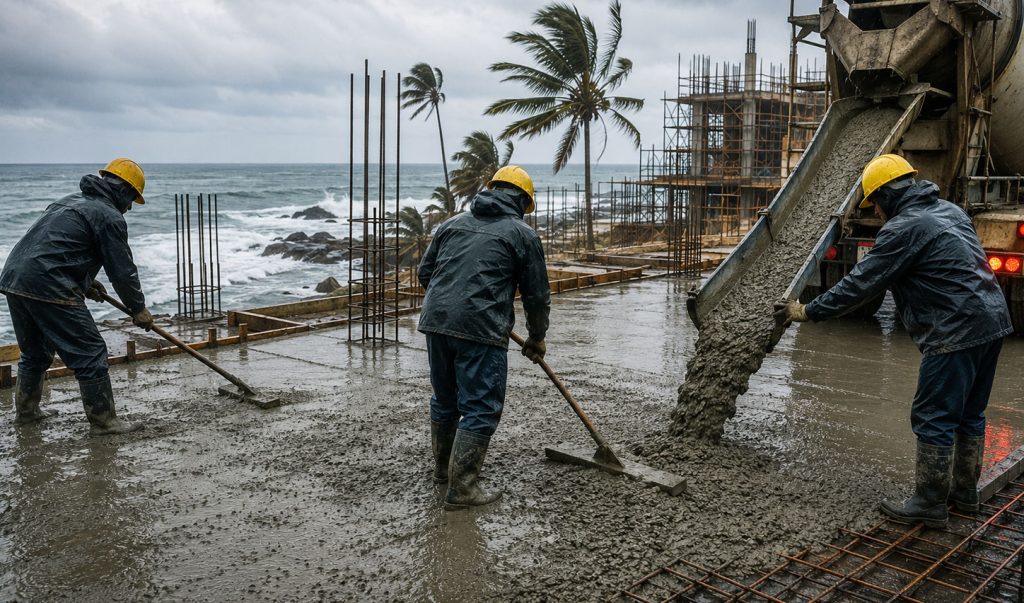
When the Environment Becomes an Integral Part of Design
Concrete pouring in a humid coastal climate is far more than just discharging a mix of cement, water, and aggregates into formwork. It is a rigorous litmus test for engineering precision, operational discipline, and our profound understanding of the physicochemical behavior of materials against environmental stressors. In coastal cities—where humidity levels often reach environmental saturation, prevailing sea breezes carry chloride ions, and morning mists perennially blanket the job site—concrete ceases to be a “passive” or “predictable” material. Under these conditions, environmental parameters migrate from the background directly into strategic engineering decision-making.
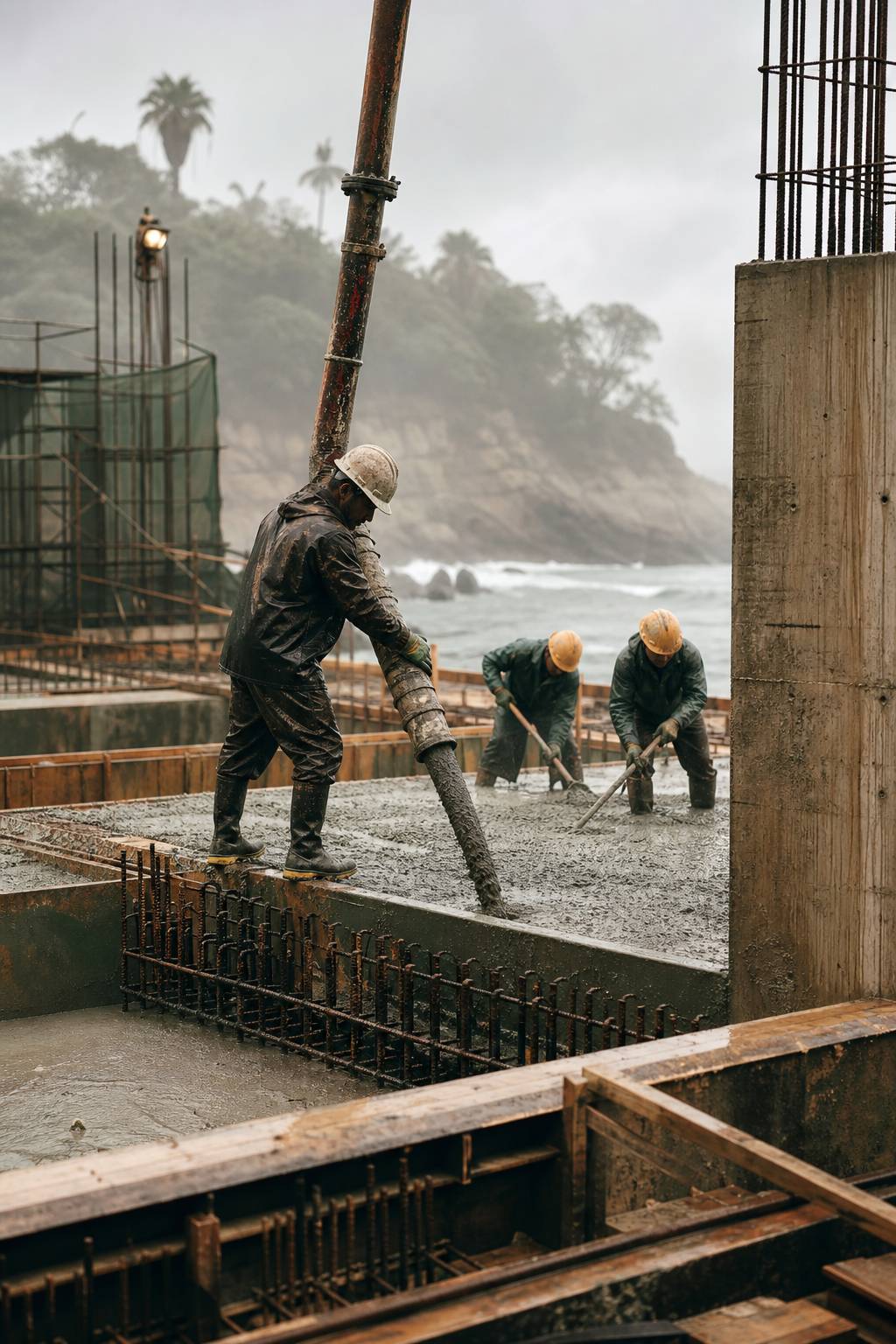
Description: A high-angle, wide shot of a major coastal infrastructure construction site at sunrise. Heavy morning mist hangs over the reinforced concrete columns and formwork. The ocean is visible in the background. The lighting is cold and atmospheric, emphasizing the damp, high-humidity environment.
Every project executed in such environments faces a simple yet defining question from the mix design phase to the stripping of forms: Are the measures taken truly engineered for this climate, or are we merely applying generic templates meant for arid or temperate zones? The answer determines the boundary between a resilient structure that stands for decades and one that, within a few years, imposes the hidden costs of its deficiencies through hairline cracks, persistent efflorescence, and reinforcement oxidation. In humid climates, errors do not manifest immediately; they lie dormant within the microscopic layers of the concrete. By the time visual symptoms appear, it is often too late for fundamental remediation.
High Humidity: Ally or Adversary to Hydration?
High humidity is not inherently an enemy of concrete; in fact, if controlled, it can facilitate a more thorough cement hydration process. However, the challenge lies in “excess environmental water” which disrupts the delicate equilibrium of the water-to-cement (W/C) ratio. Concrete requires a specific hydration regime to achieve its design strength. When ambient humidity is excessively high, the evaporation of “free water” is delayed. While this initially seems positive as it prevents plastic shrinkage cracking, if unmanaged, it leads to a weak surface laitance, scaling, and ultimately, increased permeability.
In coastal zones, the issue extends beyond water vapor to “Chloride Ions.” these airborne salt particles gradually penetrate the concrete’s surface pores. If the concrete is not sufficiently dense and the W/C ratio is not stringently controlled, these ions act like infiltrators, breaching the defenses to reach the reinforcement. The chemical reaction between chlorides and steel triggers active corrosion and expansive pressure, eventually disintegrating the concrete from within. Consequently, concrete in this climate must be an “impenetrable fortress,” not just a hardened mass of cement.
Timing: The Golden Hours Post-Pour
The critical threshold of concrete quality is determined within the first few hours following placement. In humid climates, this “window of opportunity” is significantly tighter and more volatile because atmospheric shifts occur rapidly. A calm morning can escalate into a humid storm or dense fog within an hour. The pouring crew must understand “atmospheric dynamics.” During these early hours, concrete is in a transitional state—neither liquid nor fully solid. Any physical disruption at this stage directly diminishes the cohesion of the cement paste.
Coastal regions exhibit a specific phenomenon: “Delayed Setting.” High humidity retards the initial setting time, meaning the contractor must manage the final finishing with surgical precision. If finishing is performed prematurely, excess surface water is re-incorporated into the matrix, weakening the top layer. If performed too late, the concrete becomes susceptible to shrinkage cracks. This balance is not found in textbooks as a fixed number; it is “field intelligence” gained by the site supervisor through tactile assessment of the surface and understanding the instantaneous evaporation rate.
Mix Design: The Cornerstone of Durability in Aggressive Environments
The most prevalent error in coastal projects is the utilization of standardized, general-purpose mix designs. These environments demand High-Durability Concrete (HDC). This necessitates the use of supplementary cementitious materials (SCMs) such as Silica Fume or Fly Ash to achieve “Pore Refinement,” preventing corrosive ions from ingressing. Furthermore, precise W/C ratio control is vital; an unnecessary increase of even 0.05 in this ratio can exponentially increase permeability.
An often-overlooked factor is the Alkali-Silica Reaction (ASR). In humid zones, if the aggregates are reactive, environmental moisture acts as a catalyst, triggering internal expansion and catastrophic cracking. Engineers in coastal climates must prioritize aggregate reactivity testing. In this context, the 28-day compressive strength obtained in the lab is only half the story; the more critical narrative is the concrete’s long-term performance within an aggressive chemical environment.
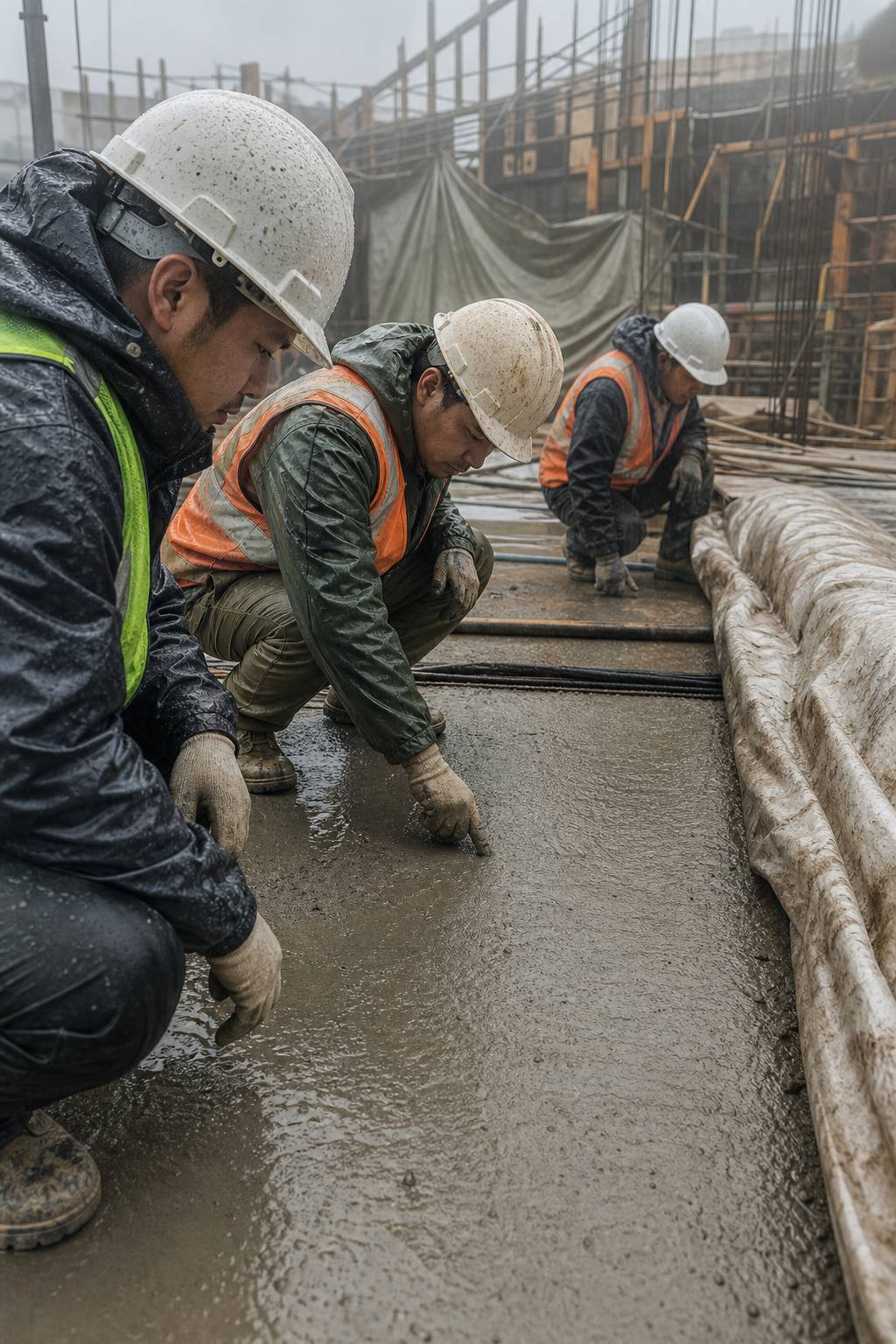
Description: Close-up of a QC technician in protective gear performing a concrete permeability or chloride migration test in a site laboratory. Focus is on the specialized testing equipment and the technician’s focused hands. Clean, modern, scientific aesthetic.
Risk Management in Critical Conditions (Sudden Rainfall)
One of the greatest logistical challenges on coastal sites is the onset of sudden precipitation during pouring. Many contractors fail to halt operations during light rain, which is a major risk. Even light rain instantly alters the W/C ratio of the top layer, rendering the surface “friable” and prone to scaling.
A professional protocol for such contingencies includes two pillars: First, the immediate availability of mobile canopies or heavy-duty waterproof tarps to cover fresh surfaces. Second, if rainfall intensifies, pouring must cease and a “Construction Joint” must be established according to engineering principles. Rainwater must never be allowed to pool in the forms; it must be fully evacuated before resuming operations. A team without a contingency plan is the most vulnerable asset in a coastal climate.
The Importance of Pre-Pour Communication and Checklists
Why do some projects succeed even in the worst weather? The answer lies in the “Pre-Production Culture.” In leading projects, no pour commences without a rigorous Toolbox Talk. These sessions involve not just the labor force, but inspectors and ready-mix suppliers. Pre-pour checklists must transcend “formwork cleanliness” to include 12-hour weather forecasts, plant production capacity under specific conditions, and logistics for rapid discharge.
In humid climates, radio communication between the batching plant and the site is vital. If aggregate moisture changes at the plant, the added water in the mixer truck must be adjusted immediately. Many contractors neglect these adjustments, assuming the change is negligible. In a humid climate, “negligible” is the difference between a permeable and an impermeable structure.
Curing: Where Projects Often Fail
In high-humidity areas, the most common fallacy is assuming that “the air does the curing.” This is a major calculation error. While the air is humid, is it sufficient for the complete hydration of all cementitious components? More importantly, does it prevent temperature fluctuations? Coastal climates can create “Thermal Gradients” between day and night. If the surface cools faster than the core, tensile stresses develop, leading to thermal cracking.
Curing in humid climates must be synonymous with “Uniform Protection,” not just wetting. Protective covers (such as wet burlap or high-quality polyethylene films) must be used to control rapid evaporation and insulate the surface against cold sea winds. Curing in these regions must be active, not passive.
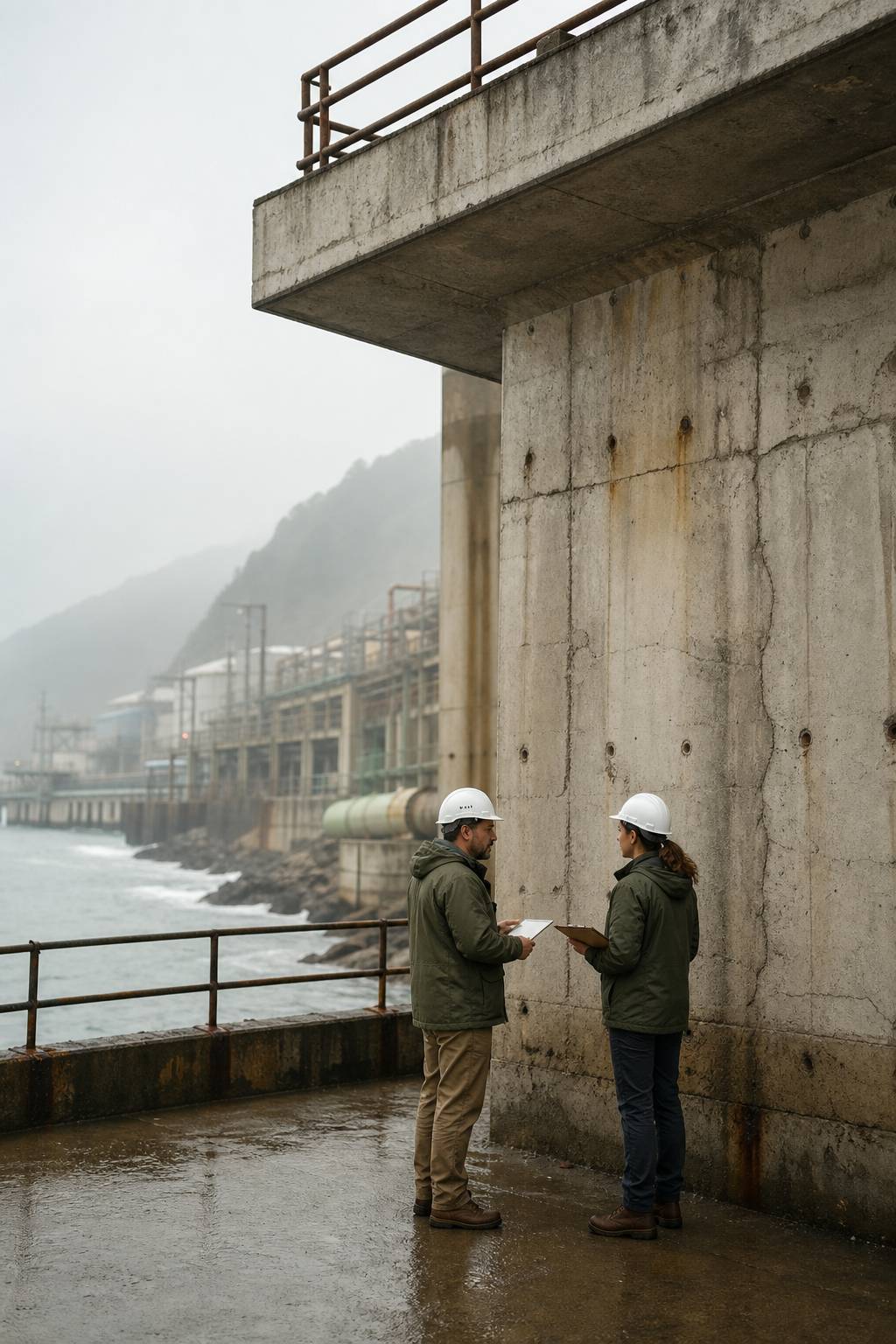
Description: A close-up, sharp-focus shot of newly stripped concrete columns wrapped meticulously in heavy-duty curing blankets and geotextile sheets. Water drops are visible on the protective cover, showing a clean, high-spec, well-managed site.
Quality Control: A Proactive, Not Reactive Approach
In humid climates, Quality Control (QC) must evolve beyond simple cylinder sampling. We must monitor “Performance Indicators.” Is the surface moisture uniform in the early hours? Is the shrinkage rate as expected? Does the final level indicate excessive bleeding?
A vital test for coastal zones is the Permeability Test. Compressive strength exceeding design specs can be deceptive. High-strength concrete with high permeability is destined for failure in a coastal environment. We need “Impermeability.” Therefore, durability tests such as Water Absorption and Chloride Ion Penetration must be part of the QC routine. Skipping these tests is a gamble for which the building owners will eventually pay the price.
Life Cycle Costing (LCC) and Project Economics
For developers and investors, “cost” is always the priority. Here is a harsh reality: high-quality concrete work in coastal climates might cost 20% more than conventional methods upfront. However, a Life Cycle Cost (LCC) analysis reveals that this extra cost is actually a high-yield investment.
If a structure requires major repairs, resin injection, or reinforcement rehabilitation after only 10 years due to chloride ingress, those costs will far exceed the initial 20% premium. Beyond financial costs, the “Loss of Use” (e.g., evacuating a commercial building for repairs) is staggering. When these factors are integrated into economic models, precise engineering in humid climates emerges not just as a technical necessity, but as a “Financial Imperative.”
Final Word: Respect for Nature, the Key to Stability
Concrete pouring in coastal and humid regions is an arena where engineering meets the forces of nature—a nature that constantly seeks to dissolve our chemical bonds with its moisture and salt. In this arena, our only tool is Precision: precision in mix design, precision in execution, and precision in maintenance. There are no shortcuts.
A structure is ultimately the manifestation of our thought processes. If we respect environmental humidity and treat it as a key parameter rather than a nuisance, we create structures that endure. Sustainability is the result of harmony between material science, the art of execution, and climatic understanding. This is what separates legacy structures from transient construction. In this profession, building correctly is its own reward, visible in the enduring stability and durability of the form. A resilient structure is the finest advertisement for an engineer who knows how to harmonize with their environment.