


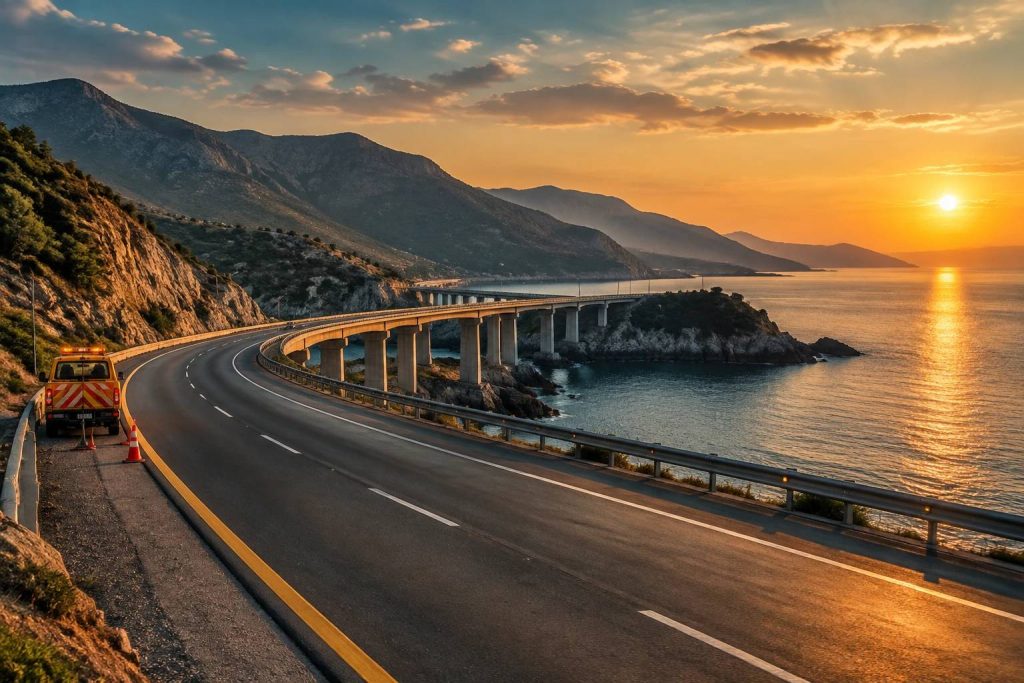
When the applause dies down, the real work of bridge and infrastructure maintenance begins. The sharp, acrid scent of bitumen still hangs in the air from the final asphalt layer, and the severed red ribbon drags limply along the curb. The officials board their SUVs, wave their final goodbyes, and the motorcade disappears into a cloud of dust. For them, the file is closed. The provisional acceptance certificate is signed, the press photos are live, and the overtime for the administrative staff has been processed. For engineers and asset managers, however, this is the beginning of the structure’s service life—and of the inspections, preventive maintenance, and corrosion control needed to keep it safe.
But when the sun dips behind the hills and the salt-laden sea breeze begins to howl through the piers, the structure’s true solitude begins. High up, on the main girders, there is no eye to witness the heavy tremors of a forty-ton trailer—vibrations that penetrate down to the very core of the foundations and echo back.
Concrete may look like an inanimate lump of stone, but anyone who has placed a hand against a slab knows that beneath this cold crust, a living organism is struggling. The moment the traffic load hits, the structure begins to fight. At night, in the biting cold, it contracts; at noon, under the scorching sun, it expands. This constant expansion and contraction is like a heartbeat that never stops. Disaster is born the moment we delude ourselves into believing this gray giant will stand proud and untouched forever. No stone crumbles on its own; a structure is not merely stone—it is a reservoir of trapped stresses.
How Coastal Weather Accelerates Concrete and Rebar Corrosion
You have to witness the bone-chilling winters and the muddy autumns of this climate to understand what water does to concrete. The wind blowing from the Caspian isn’t a gentle breeze; it is a heavy, corrosive mist laden with microscopic salt particles that lash out at every pore. This wind dusts the slabs and piers with salt like a toxic powder. With the first heavy rain, the water dissolves these chloride ions and drives them deep into the concrete’s capillary network. This invisible migration continues silently for months and years. The chlorides attack the protective alkaline layer of the rebar, causing chloride-induced corrosion, and the steel begins to oxidize in the dark heart of the concrete. In practical terms, coastal exposure turns water ingress and rebar corrosion into two of the most important bridge-maintenance risks.
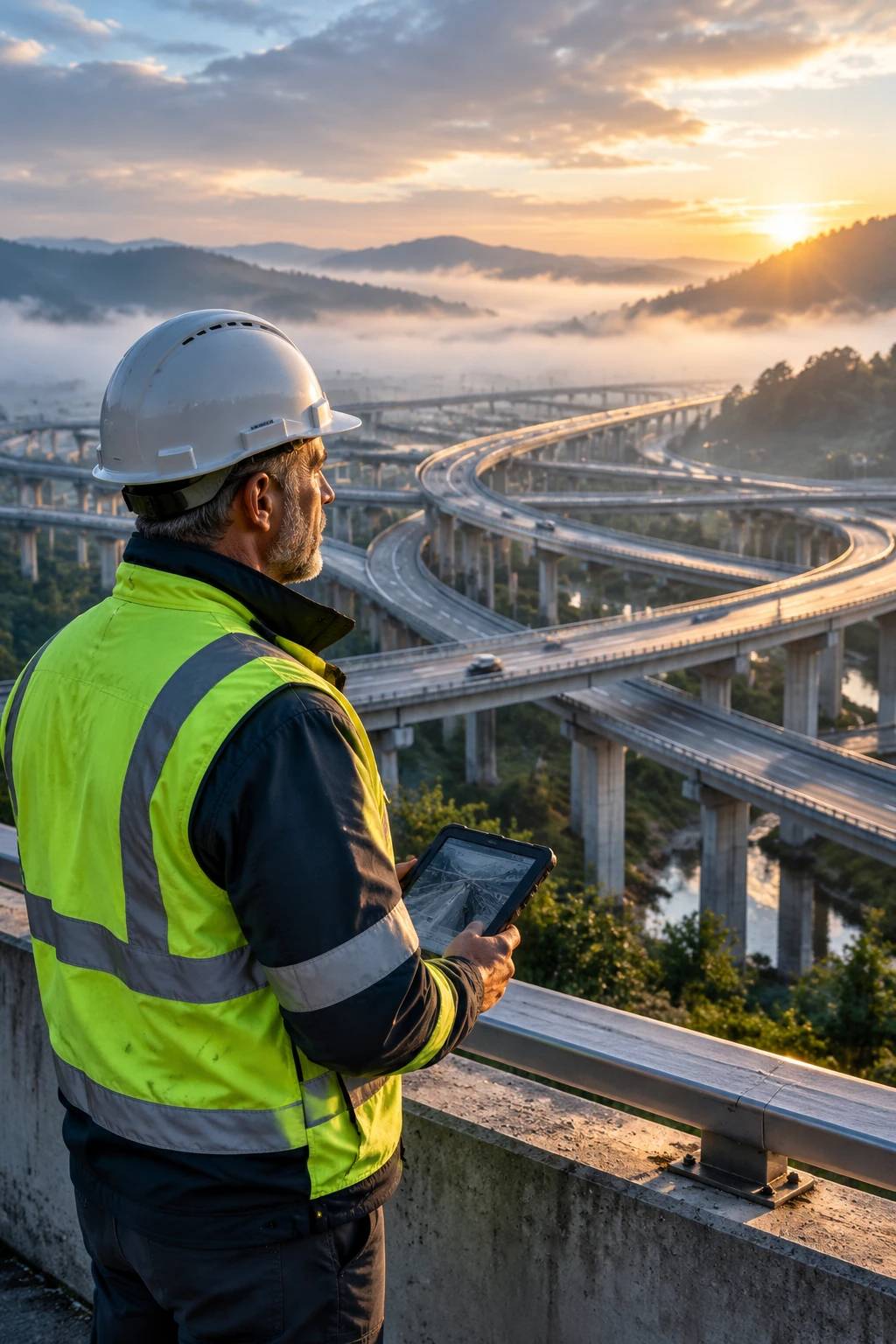
Rust occupies six times the volume of healthy steel. This means a steel wedge is expanding from within, shattering the concrete’s belly. From the outside, you might see only a faint yellow stain, but beneath the surface, the concrete cover has delaminated and is ready to spall. When temperatures plummet below zero in winter, the water trapped in these cracks freezes, expands by nine percent, and rips through the concrete walls like gunpowder. This silent war repeats every single night. If left unattended, structures will reach their “senescence” together—and by then, a trickle of maintenance budget won’t even cover the cost of the demolition, let alone the repair.
Bridge Bearing Failure: The Hidden Risk Beneath an Expansion Joint
It was three years ago, in autumn. The previous week’s relentless rain had washed out the valleys, and the sharp scent of wet earth hung heavy in the crisp morning air. The project was a long-span cable-stayed bridge, a vital artery for goods transit from the southern ports. On the surface, everything looked perfect: the white lane markings were flawless, the guardrails gleamed, and vehicles sped across the expansion joints at 100 km/h with nothing more than a faint, rhythmic “thud.” The monthly maintenance reports flowing into the central technical office were all marked “Green.” No potholes on the deck—so, to the management system, there was no cause for concern.
But when we descended through the narrow access hatch beneath the deck, armed with a moisture-resistant flashlight and a hard hat, reality proved otherwise. A heavy, stagnant dampness—reminiscent of the air in abandoned subway tunnels—choked the space beneath the main girders. In Span 4, directly beneath the modular expansion joint, a dark gray stain marred the concrete bearing of the main girder. From above, the joint looked pristine. From below, however, the failed expansion-joint seal had allowed water, salt, and road debris to reach the bridge bearing. Torn by years of cyclic thermal movement and abrasion from road sand, the elastomeric seal was no longer protecting the neoprene bearing or the pier cap. Salt-laden de-icing runoff had been dripping for consecutive winters, like a slow IV drip, directly onto both components.
The scene was harrowing. The elastomeric bearing, under asymmetric pressure and constant contact with oil and salt, had bulged, exposing its internal steel shims. Crystallized salt had formed a white, swollen crust around the post-tensioning anchorages at the pier head. When I tapped the edge of the concrete bearing with a geological hammer, a brick-sized chunk fell away without resistance and crumbled to powder in my hand. Beneath it, the shear reinforcement was completely corroded, its cross-section reduced by half. The structure was still standing, but it was essentially sitting on a mechanical fault line. Had a heavy truck slammed on its brakes on that span, the shear force could have “sheared” the crushed bearing, causing the main span to drop several centimeters—a catastrophe that would have paralyzed the entire transit highway for months, with costs exceeding the bridge’s original construction price.
The emergency meeting in the site office that day was one of the bitterest of my career. The executive deputy insisted this was merely a “localized settlement” and “minor dampness,” suggesting we just patch it with cementitious mortar and epoxy paint to pass the annual audit. They found it impossible to accept that a $200 unreplaced seal had held a $50 million structure hostage. We were forced to execute a grueling night operation: limiting traffic to a single lane, jacking up the main girder by a mere four millimeters with 200-ton hydraulic jacks, extracting the crushed bearing, hydro-blasting the honeycombed concrete, installing remedial rebar, and rebuilding the bearing with non-shrink, high-strength grout. That night, until dawn, the roar of the hydraulic jacks and the vibration of the piers reminded us that the boundary between a national disaster and operational safety is sometimes as thin as a single, honest inspection in the dark.
Preventive Bridge Maintenance: Warning Signs Before Structural Failure
No bridge collapses without a warning. Structures are not stupid; they groan, they vibrate, and they write their signs on the walls months before they yield. The problem is that we have habituated our ears to the sound of traffic and our eyes never look beyond the white lane markings. Sitting behind a desk, waiting for a deep pothole to lock the transit axis or for a bearing to crush, is not “maintenance.” It is the behavior of a man waiting for his roof to cave in before he goes looking for bricks.
When a crisis strikes, panic replaces reason. The yellow beacons flash, traffic backs up for ten kilometers, exhausted drivers hurl insults, and emergency crews scramble in the dark with cold-patch asphalt and makeshift mortar just to get the road open by morning. This reactive approach doesn’t treat the rot; it just lets it fester, returning six months later with double the severity. True maintenance is the work of patient, quiet people—the ones who, at 4:00 AM, in cold that makes metal stick to skin, stand beneath the bridge bearing to check the bolt torque on the bracing. When they do their job right, nothing happens. No cameras flash, no one says “thank you,” because the city keeps moving in peace.
An old elastomeric seal, if not replaced in time, lets rainwater mixed with road diesel drip directly onto the concrete pier cap. The concrete soaks it up, cracks open in the nightly freeze, and within two years, the pier cap—which should be carrying the deck load—becomes a porous ruin. This entire catastrophic chain could have been halted with a utility knife, a tube of polyurethane sealant, and twenty minutes of work in the right season. But the system prefers to wait until the repair cost balloons from a few dollars to hundreds of thousands, forcing them to tender a frantic, emergency repair contract.
Non-Destructive Bridge Inspection: Ultrasonic, Infrared, and Vibration Monitoring
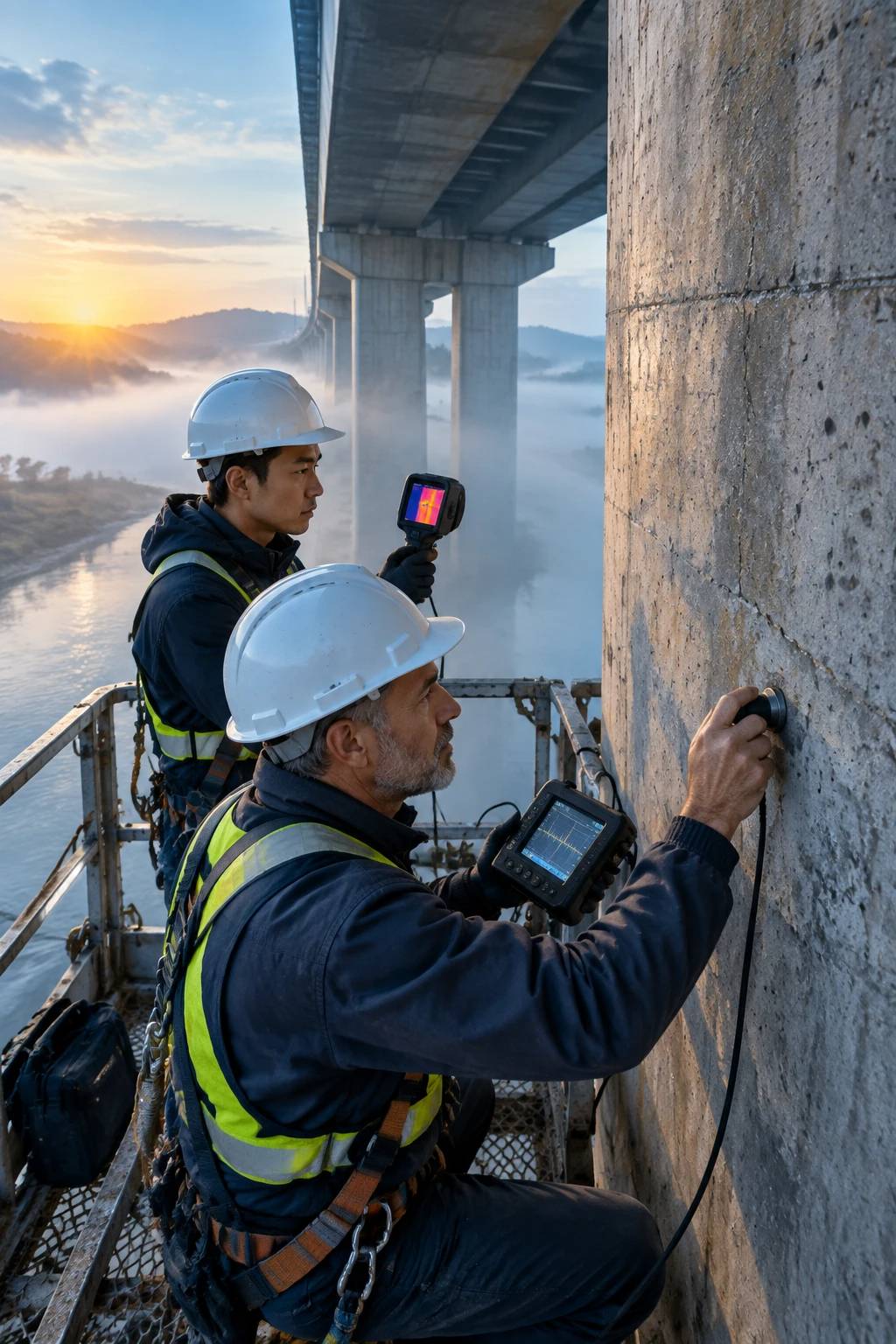
Wooden hammers and tapping on concrete to “listen” for hollow sounds no longer solve the problem; massive structures have thick layers that the human eye and ear cannot penetrate. Modern non-destructive testing (NDT) methods allow engineers to inspect bridge components without removing sound material. When an ultrasonic probe is placed on the concrete surface, the device’s subtle clicks capture the internal pulse of the element. If the sound wave hits a honeycombed void or a fatigue-induced crack halfway through, the return time lags—telling us that, somewhere fifteen centimeters deep, the particle cohesion is broken.

In the morning twilight, before the sun heats the concrete skin, infrared cameras reveal a different reality. Areas that have “stolen” water or where the underlying bitumen has blistered reflect yesterday’s heat at a different rate than the solid sections. On the monitor, the color variations glow like bloodstains in the dark. The engineer reading this screen doesn’t need to plow up the asphalt with a jackhammer; they know exactly how the water blisters are delaminating the topping from the slab.
Great bridges are like giant musical instruments. Every bridge oscillates at a specific frequency based on its span and weight. Accelerometer sensors attached to the cables and girders in the dark beneath the deck listen to this constant rhythm. If one day this rhythm is off by even half a second, the balance is lost—perhaps a post-tensioned tendon has snapped, or one of the intermediate piers has settled slightly into the riverbed mud. This warning flashes on the monitor long before a crack appears, giving us the chance to position the hydraulic jacks beneath the girder before the entire span gives way.
Life-Cycle Cost of Infrastructure Maintenance and Repair
Money speaks a brutal language, especially in civil projects where the budget zeros line up one after another. The life-cycle cost of infrastructure includes construction, inspection, routine maintenance, rehabilitation, and emergency repair—not just the original capital budget. Those who think spending on a well-equipped inspection team is a waste of capital have never seen the invoice for the emergency reconstruction of a collapsed bridge. Once concrete fails, it doesn’t return to its original state through kindness and prayers. If you don’t spend a few hundred dollars on an expansion joint, the rainwater rots the pier reinforcement, the main girder shifts, and five years later you’ll have to spend a hundred times that amount to lift the entire deck and re-form the piers—not to mention the loss of life and the economic cost of a paralyzed highway.
Projects are measured on paper by construction costs, but the reality of the site is that a structure consumes seventy percent of its cost during its forty-year lifespan. If a structure is built poorly and maintained worse, it becomes a patient perpetually on life support, swallowing chunks of current revenue just to stay alive. Value engineering is not about reducing concrete thickness to save the contractor money during construction; it is the art of arranging details so that thirty years later, reaching a simple bearing doesn’t require paralyzing the capital’s traffic flow. A structure that requires sleight-of-hand and the demolition of half its healthy elements just to be repaired was born dead on the drafting board.
In our site culture, we tend to glorify the heroes who set records for concrete pours and move mountains of earth. But the real hero is the technician who, in sub-zero temperatures, hangs from the edge of the cornice by a rope to ensure the drain is not frozen. They are the ones keeping the nation’s capital afloat, without their names ever being carved into a bronze plaque.
Why Preventive Bridge Maintenance Protects Public Safety
Ultimately, it all comes down to this: we build structures to endure, not just to shine during our tenure. These bridges and highways have risen from the ashes of history and the sweat of workers who labored under the scorching desert sun and the freezing mountain winds. To abandon them to the wind and rain is a disrespect to the very forces that built them.
The colorful ribbons will be crushed under truck tires by tomorrow morning, the passionate speeches will be lost in the wind, and the managers’ names will fade from memory. But that giant concrete girder will stand under the weight of vehicles for decades to come. If we do not look at it today, if we do not take its small cracks seriously, and if we do not treat the structure like a living thing, the day will come when this proud concrete crumbles in silence, leaving us alone amidst the rubble of our own negligence. The future of infrastructure is built by those who, after the photographers leave, pick up a wrench and stay on the job.