



At the beginning of a large construction project, the budget usually appears logical and defensible. Quantities have been measured, prices have been collected, and the costs of materials, execution, equipment, and labour have been estimated to a reasonable extent. A contingency is often included for known risks as well.
In early meetings, everyone talks about cost control. The general assumption is simple: if procurement is managed properly and payments remain disciplined, the project will remain financially safe.
A few months later, however, the same project often faces a familiar reality. Costs have exceeded the original ceiling, even though no single catastrophic event has occurred.
The structure has not necessarily failed. Not every contractor has performed poorly. No single material has destroyed the budget on its own. Instead, the project has absorbed a series of smaller events: decisions made too late, drawings that did not work on site, purchases that appeared inexpensive but consumed time, “minor” changes that created major consequences, and site teams that were present but not producing meaningful output.
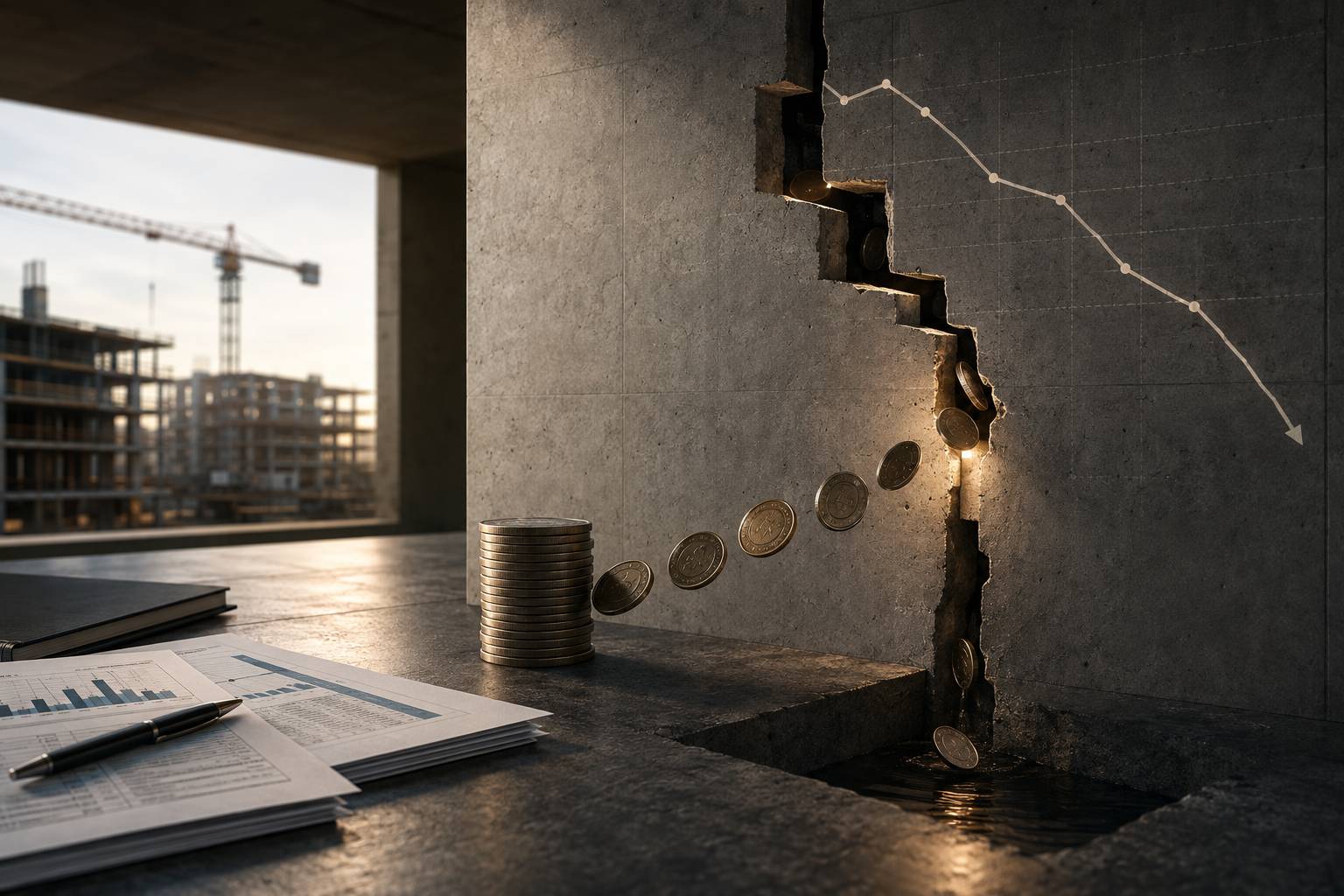
The core problem is that a significant share of a project’s real cost is not visible in the original cost plan. Not because anyone intended to hide it, but because it had not happened yet. These costs are created at the moment of decision, grow during execution, and usually become visible in financial reports only when it is too late to prevent them.
A project budget is not lost on the day an interim payment is made. It is often lost weeks earlier, in a meeting where an important decision was left unanswered.
Two Projects
Every large project has at least two versions.
The first is the version shown in the schedule, approved budget, drawings, meeting minutes, and formal reports. In this version, progress percentages are defined, activities have dates, and costs are recorded in measurable categories.
The second is the project that actually exists on site: unanswered calls, approvals that have not yet been issued, materials that have not arrived on time, drawings open to multiple interpretations, contractors waiting for instructions, and managers trying to keep the project moving without bringing the site to a full stop.
The gap between these two versions is where hidden costs are born.
A formal report may state that the project is 40 percent complete. In reality, however, part of that 40 percent may not yet represent secured value. A substrate may be complete while the final material specification is still changing. MEP routes may have been installed while the final ceiling height remains unresolved. Equipment may have been purchased while its installation area or required infrastructure is not ready.

In this situation, the project appears to be progressing. Yet part of that progress may later turn into rework, demolition, replacement procurement, or repeated execution.
A professional project manager does not simply ask:
“How much work has been completed?”
The more precise question is:
“How much of the completed work is truly final, coordinated, and ready for handover?”
That small shift in the question can completely change the financial picture of a project.
Three Failure Points
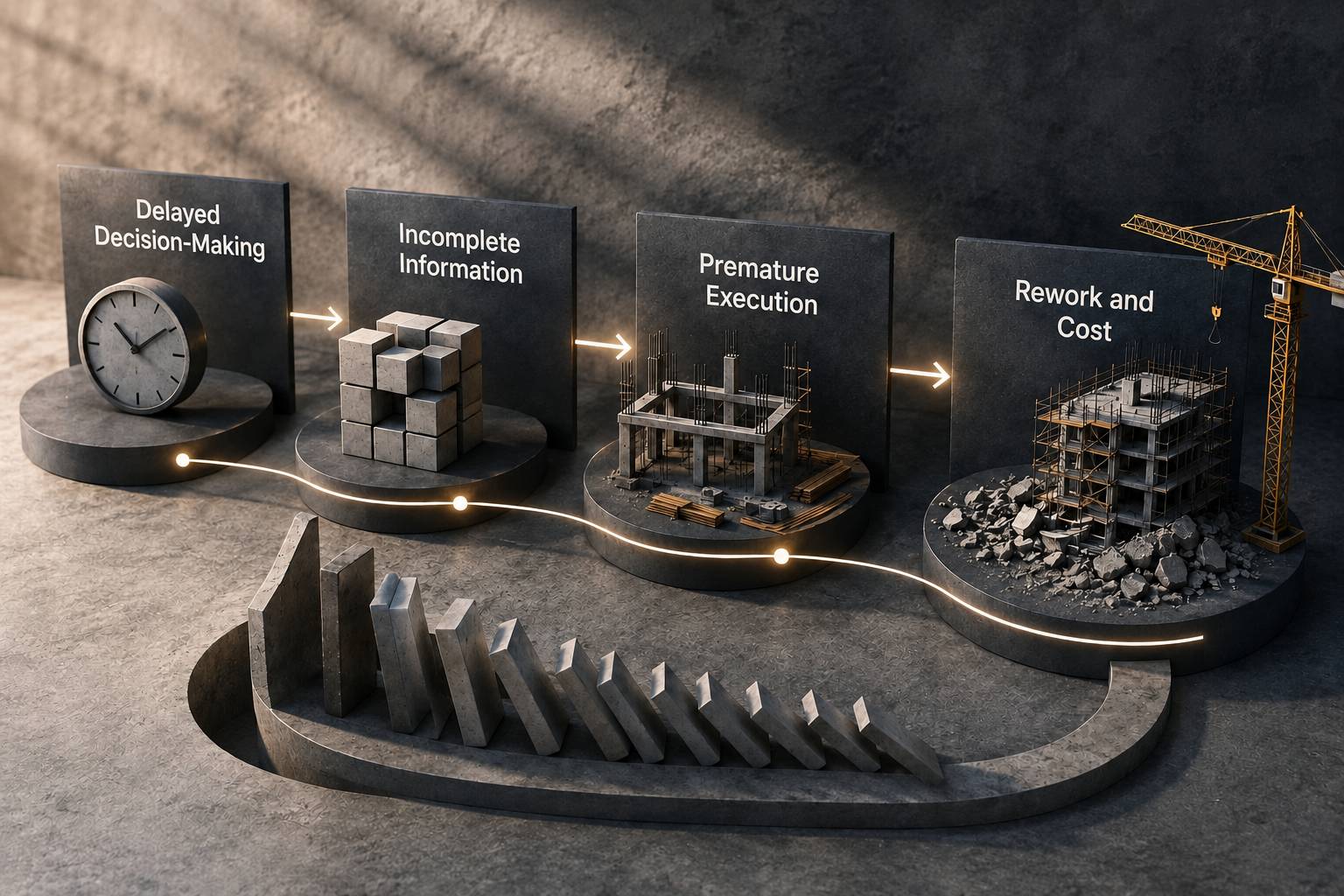
A large portion of hidden costs in major projects emerges where three factors collide:
Each factor can be managed on its own. A delayed decision may be offset through schedule adjustments. Incomplete information may be resolved through a coordination meeting or a detailed construction drawing. Early execution may sometimes be unavoidable in order to protect the programme.
But when all three happen at the same time, the project enters a danger zone.
The site begins work to avoid a complete stoppage, while the required information is still incomplete. Decision-makers have not reached a final conclusion on critical details. A few days or weeks later, a new instruction arrives, and it becomes clear that part of the completed work must be revised.
At this point, the cost is not limited to demolition or re-execution. The entire project must adapt to a decision that arrived too late.
This pattern appears in façades, MEP systems, interiors, landscaping, equipment, access routes, and even operational planning. On the surface, each issue may appear independent. In reality, many are different versions of the same underlying weakness.
A project that identifies these three failure points early still has time to respond. A project that ignores them usually reaches the end asking:
“Where did all these additional costs come from?”
The answer is often straightforward: from the places where decisions were not final, information was incomplete, and execution started too early.
Silent Delays
Not every delay comes with a fully stopped construction site. In fact, many of the most expensive delays occur while the site appears completely active from the outside.
The crane is operating. Teams are moving around. Materials are being transported. The daily report records multiple ongoing activities. Yet beneath that activity, the project may be losing both time and money.
Imagine that the final decision on the façade system for a key section of the building is delayed by ten days. On paper, ten days may not seem significant. The execution team can temporarily move to another workfront, and some activities can continue.
In reality, however, that delay is not just ten days.
Profile orders remain on hold. The substructure team cannot finalise its programme. Connection details with the structure remain unresolved. Related MEP routes may need to be reviewed. Scaffolding or access equipment becomes underused in part of the site. Teams are relocated, and bringing them back to the same workfront later requires additional time and money.
Once the final decision is eventually made, the project typically reacts in a predictable way: pressure to recover lost time is pushed into later stages. Procurement becomes more rushed. The programme becomes tighter. Parallel activities increase. Quality becomes exposed to risk.
This is a silent delay. It may never appear in a formal report under the title “cost of delayed decision-making,” but its effects spread everywhere: lower productivity, overtime, weaker procurement choices, clashes between teams, and reduced negotiating power with suppliers.
In a large project, delay does not only consume time. It also removes good options from the project. The later a decision is made, the fewer choices remain—and the more expensive those choices become.
Suggested file: 89653bb8-14ac-4177-972a-0cdfe1d142a0_compressed.jpg
Caption: Delayed decisions create an unstable balance between time, cost, quality, and site productivity.
Alt text: Unstable project balance showing the tension between time, cost, and execution pressure.
The Incomplete Drawing
One of the most expensive moments in any project occurs when execution moves ahead of design.
A drawing may look complete. Plans, sections, details, and even a three-dimensional model may exist. But having a complete-looking document is not the same as having a document ready for construction.
A construction drawing has real value only when a contractor can execute the work without guessing, personal interpretation, or temporary on-site solutions.
The problem begins when architecture has made one decision, the structural system creates another limitation, and MEP requires a different route. In the design office, this conflict may seem manageable. On site, however, the project is dealing with completed concrete, actual heights, purchased equipment, labour, access limitations, and a compressed programme.
Consider a common example: a ceiling that is intended to remain simple, clean, and visually continuous from an architectural perspective. During execution, it becomes clear that the space required for ducts, pipes, cable trays, fire systems, access panels, and technical equipment does not align with the intended architectural height.
If this issue is identified before execution, several solutions can be considered. But if it becomes visible after part of the substructure, MEP installation, or suspended ceiling has already been completed, the issue is no longer merely a design matter. It becomes a financial and scheduling decision.
Rework is not simply demolition followed by re-execution. Rework means the project has paid for something that did not create final value. Materials have been consumed. Labour has spent time. Equipment has been occupied. The site has been disrupted. Management attention has been drained—without adding a deliverable asset to the project.
The construction site should not be the place where problems are discovered that could have been resolved before execution began.
This principle is simple, but respecting it is one of the clearest differences between a project that is managed and a project that is merely pushed forward.
Expensive Change
Change is not necessarily a bad thing in a project. Market conditions, operational needs, investment priorities, or quality expectations may evolve. Insisting on keeping everything unchanged can sometimes be the wrong decision.
The issue is not change itself. The issue is when the change enters the project—and how it is managed.
Imagine that the client decides to upgrade a defined area from office use to a service, hospitality, or reception-oriented space. From a commercial perspective, the decision may be entirely justified. But if it is made when MEP works, flooring, lighting, and part of the finishes are already underway or complete, the function of the space is not the only thing that changes.
Electrical capacity may need to be reviewed. Ventilation may require redesign. Access routes can change. Interior details, materials, layouts, equipment, procurement lead times, and handover dates may all be affected.
What was introduced in a meeting as a “small change” becomes an execution wave on site.
A professional project manager should not ask only:
“How much will this change cost?”
The more accurate question is:
“If we make this change, what visible and hidden costs are we accepting at the same time?”
The visible costs include redesign, new procurement, and additional execution. The hidden costs include disrupted sequencing, revised orders, delayed handover, pressure on contractors, a higher likelihood of errors, and reduced quality during the final stages.
A professionally managed change has a defined scope. Its impact on cost and time is documented. Responsibility for execution is clear. And before it reaches the site, its execution path is closed and agreed.
Any change that enters execution without this process—even a small one—has the potential to create major cost.
Cheap Procurement
In large projects, buying at the lowest price is often the most attractive decision on paper—especially when the budget is under pressure and everyone is searching for numbers that will improve financial reporting quickly.
But the purchase price is only one part of the real cost of a decision.
A cheaper piece of equipment or material may have a less reliable delivery date. Its quality may vary between batches. Installation may be more difficult. It may require more corrective work. Spare parts and technical support may be difficult to access in the future.
In such cases, the project saves money at the moment of purchase but pays more during execution and operation.
Imagine that equipment has been purchased and delivered to site, but the installation area cannot yet be used because the supporting infrastructure is incomplete or the drawings are not final. The equipment remains in storage. Meanwhile, the project is paying for transport, unloading, storage, protection, damage risk, possible relocation, and tied-up capital.
The procurement report may describe the decision as successful. In reality, part of the project’s cash flow has been locked without creating value.
An economic decision should be assessed through the lens of life-cycle cost, not only invoice price:
Sometimes, a more expensive option is more valuable simply because it can be delivered reliably at the required time. Sometimes, a higher-cost material protects several weeks of the programme because its quality is consistent or installation is simpler.
Weak projects look for the lowest price. Professional projects look for the lowest-cost outcome.
These are never the same thing.
A Busy Site
A busy construction site is not necessarily a productive one.
In some projects, activity is simply the polite appearance of poor planning. Everyone seems busy, yet no one is sure whether today’s work will need to be reopened tomorrow.
A site may be full of workers, tools, materials, and movement. But a closer look often reveals that part of this energy is being consumed by waiting, relocation, correction, and late coordination. A team may be waiting for materials. A contractor may find that its work area is not ready. A worker may return to the same location for the third time. A crew may leave work unfinished because another team has created a conflict.
All of these have a cost.
Productivity is not determined by labour skill alone. Even the strongest execution team cannot remain productive without final drawings, sufficient materials, a ready workfront, and logical sequencing.
In this situation, the project pays for labour presence, but the output does not match the expected programme or cost.
This form of waste is particularly dangerous because it rarely appears as a visible crisis. No daily report says:
“Three hours of crew capacity were lost because a final approval was missing.”
But if that happens across multiple workfronts over several months, the accumulated amount can exceed the cost of a major construction item.
The sign of a healthy site is not the volume of activity. A healthy site is one where every team knows what to do, with what information, at what time, and alongside which other team.
Where that clarity disappears, hidden cost begins to grow.
The Ambiguous Contract
A weak contract does not necessarily create cost. But an ambiguous contract allows cost to remain without an owner.
When responsibilities are unclear, every execution issue can become a dispute. The contractor may see an item as outside the agreed scope. The client may see it as a natural part of the work. The consultant may expect a level of quality that has not been defined clearly enough in the documents.
In the process, the project does not only lose money. It also loses time and management focus.
Meetings become more frequent. Correspondence increases. Approvals slow down. Decisions are postponed. Teams become more cautious and less responsive in order to avoid liability. Eventually, an issue that could have been managed through a few precise clauses and a clear procedure turns into a draining conflict.
A professional contract is not intended to make relationships more complicated. On the contrary, it should produce clear answers during the difficult days of a project.
Scope of work, quality standards, procurement responsibilities, change procedures, approval methods, handover criteria, and dispute-resolution mechanisms must be clear enough that decisions do not depend on guesswork or personal interpretation.
Management focus is one of the most expensive resources in any project. Every hour a project manager spends resolving a conflict caused by contractual ambiguity—rather than controlling quality, time, risk, and coordination—creates another hidden cost.
Real Value
Value engineering is often confused with cost reduction. Removing an item, replacing a material with a cheaper alternative, or lowering a technical specification is not automatically value engineering.
Sometimes, such decisions simply transfer cost from today to tomorrow.
Real value engineering begins with one question:
What value does this cost actually create for the project?
If removing a cost threatens the handover date, increases the risk of rework, makes maintenance more difficult, or reduces operational quality, then that removal is not necessarily a saving. It may simply shift cost to a stage where it is harder and more expensive to control.
On the other hand, a higher upfront cost can sometimes be entirely justified. A system with faster installation, equipment with lower failure risk, a material with more consistent execution quality, or a solution that allows future flexibility may appear more expensive at first—but may reduce the total cost of the project.
A professional project does not ask:
“Where can we spend less?”
It asks:
“Where does spending create real value, and where are we simply buying a new problem?”
That difference shifts the project’s mindset from superficial cost control to genuine value management.
Before the Crisis
Hidden costs show signs before they become numbers.
Meetings that happen frequently but produce no final decisions are a sign. Drawings that are repeatedly revised without resolving the main issue are a sign. Procurement packages that require review after ordering are a sign. Teams that are constantly moved from one workfront to another are a sign. Contractors who repeatedly ask for instructions instead of planning ahead are a sign.
Every project faces problems. The difference between a professional project and a vulnerable one is not the absence of problems. It is the speed of diagnosis and the quality of response.
A project that sees these signals merely as routine daily frustrations usually recognises the crisis too late. A project that reads them as warning indicators still has time to correct its course.
Budget control does not begin in a spreadsheet. It begins with observing the project accurately: knowing which decisions remain open, which workfronts have started with incomplete information, which purchases threaten the programme, and which changes have not yet revealed their full financial impact.
Final Thought
In large projects, budgets are rarely lost all at once. They are worn away through dozens of small decisions: an approval issued too late, a drawing not ready for execution, a purchase that was only cheap, a contract that cannot provide answers when conflict appears, and a site that is busy but not coordinated.
Hidden costs are dangerous because they appear small and manageable at first. But large projects multiply every small issue at scale. An ambiguity on one floor can repeat across several floors. A delayed decision can hold up multiple purchases and activities. A limited correction can disrupt the sequence of several teams.
That is why cost control is not the responsibility of the finance department alone. It is the result of decision quality, document maturity, procurement discipline, site coordination, change management, and contractual clarity.
A team that can identify hidden costs before they appear in an interim payment certificate does not merely lose less money. It also protects time, quality, professional credibility, and its ability to make better decisions.
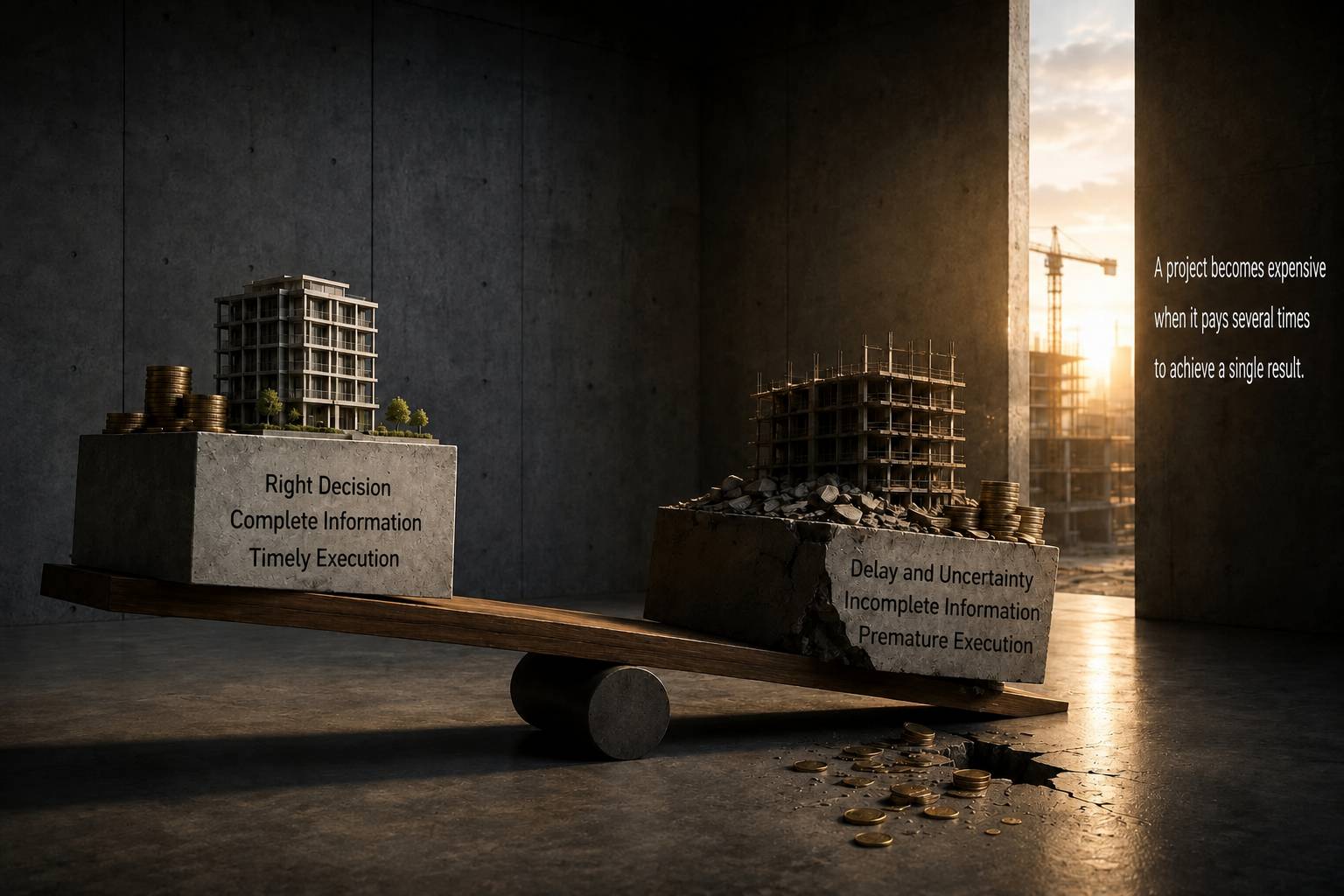
A project does not become expensive because it spends more money. It becomes expensive when it pays several times to achieve the same result.