


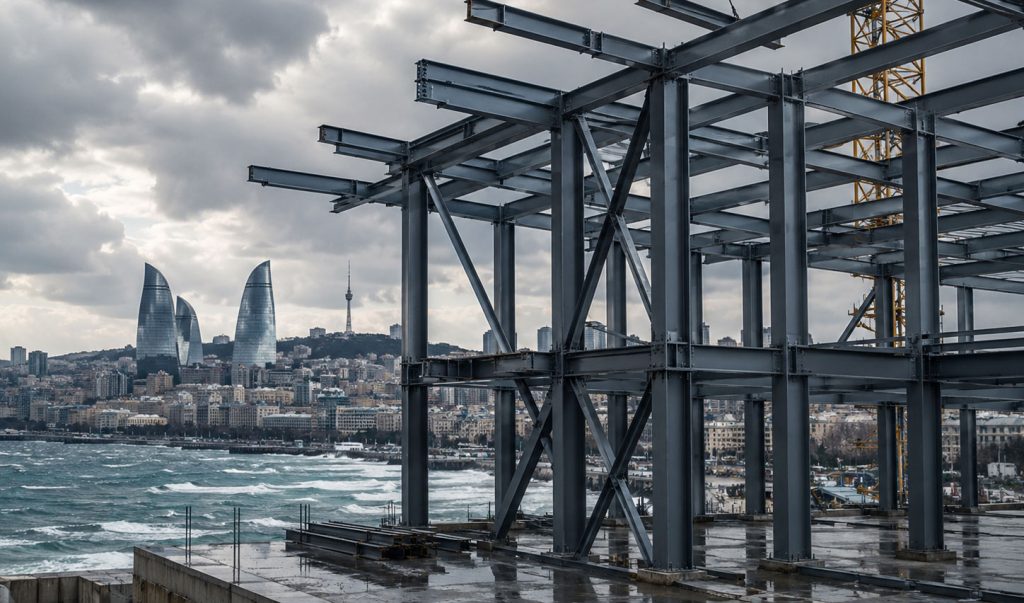
Introduction: Atmospheric and Geomechanical Analysis of Baku as a Macro-Engineering Project
Baku, the capital of Azerbaijan, has historically been known as the “City of Winds” (Baku-Badkube). From a structural engineering perspective, this city is not merely a geographic coordinate but one of the most challenging construction environments globally. Construction in the Absheron Peninsula faces a convergence of two erosive factors: first, the colossal northern winds (Khazri) and warm southern winds (Gilavar), which record instantaneous gust speeds exceeding 40 m/s; second, the saturated chloride and sulfate humidity of the Caspian Sea, which exponentially increases the corrosion rate of steel.
In such conditions, selecting a steel structure is a strategic priority due to high execution speed, an unparalleled strength-to-weight ratio, the ability to span large distances, and suitable ductility against seismic loads. However, if the design, logistics, erection, and quality control (QC) processes are not synchronized with Baku’s climatic prerequisites, the steel structure will suffer from local or global instability during the installation phases. This document serves as a comprehensive end-to-end engineering guide for the flawless execution of steel structures in this wind-prone and corrosive region.
1. Baku’s Climatic Conditions and Aerodynamic Challenges during Construction
Unlike gravity loads, wind force is dynamic and oscillatory. According to the fundamental aerodynamic formula, wind pressure () is directly proportional to the square of the wind velocity ():
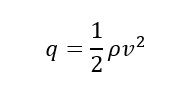
Where is air density and is wind speed. In Baku, the coastal air density is higher than in arid regions due to specific humidity and temperature, which subsequently increases the Drag Force.
The Challenge of Slender Sections During Erection:
Steel beams, columns, and trusses are highly vulnerable to lateral forces before they are integrated with concrete slabs or permanent bracing. A long plate girder suspended by a crane behaves exactly like a ship’s sail. Baku’s intermittent winds create Vortex Shedding, generating lateral vibration frequencies in the suspended member. If this frequency overlaps with the member’s natural frequency, Resonance occurs, leading to sudden rotations, Lateral-Torsional Buckling, and ultimately, member failure or operator injury.
2. Wind Load Calculations and Design Considerations per International Standards
Design in Baku cannot rely on traditional methods. In Azerbaijan, the use of Eurocodes along with National Annexes is prevalent.
Terrain Category and Roughness Analysis:
Due to their proximity to the unobstructed open sea, Baku’s shores are classified under Category 0 or Category I. This means the terrain roughness coefficient () is at its minimum, allowing the wind to hit the structure at maximum velocity without any impeding obstacles.
P-Delta Analysis (Second-Order Effects):
In Baku’s high-rise structures, lateral displacement caused by wind generates severe secondary moments. P-Delta Analysis must be performed for all wind and seismic load combinations. The lateral force-resisting system should be a combination of Special Moment Frames (SMF) in the transverse direction and Concentrically Braced Frames (CBF) or Eccentrically Braced Frames (EBF) in the longitudinal direction to provide the necessary lateral stiffness to limit inter-story drift.
3. Geotechnical Engineering, Foundation, and Base Plate Connection
Soil in Baku’s coastal areas consists mainly of loose sands and moist clays with a very high groundwater table, saturated with chloride and sulfate ions.
Chloride Attack and Galvanic Corrosion:
Chloride ions penetrate the foundation concrete, destroying the passivation layer on rebars and anchor bolts. Furthermore, the direct connection of structural steel to concrete reinforcement in the presence of saltwater creates different electrochemical potentials, leading to severe Galvanic Corrosion at the column base—where the maximum wind-induced bending moment is transferred to the foundation.
Template Placement and Millimeter-Precision Base Plate Execution:
Installing thick metal templates (preferably of the same thickness as the main base plate) to stabilize anchor bolts before concrete pouring is a technical necessity. The allowable deviation for anchor bolts, per AISC 303 (Code of Standard Practice), is less than 1/16″ (2 mm) between centers.
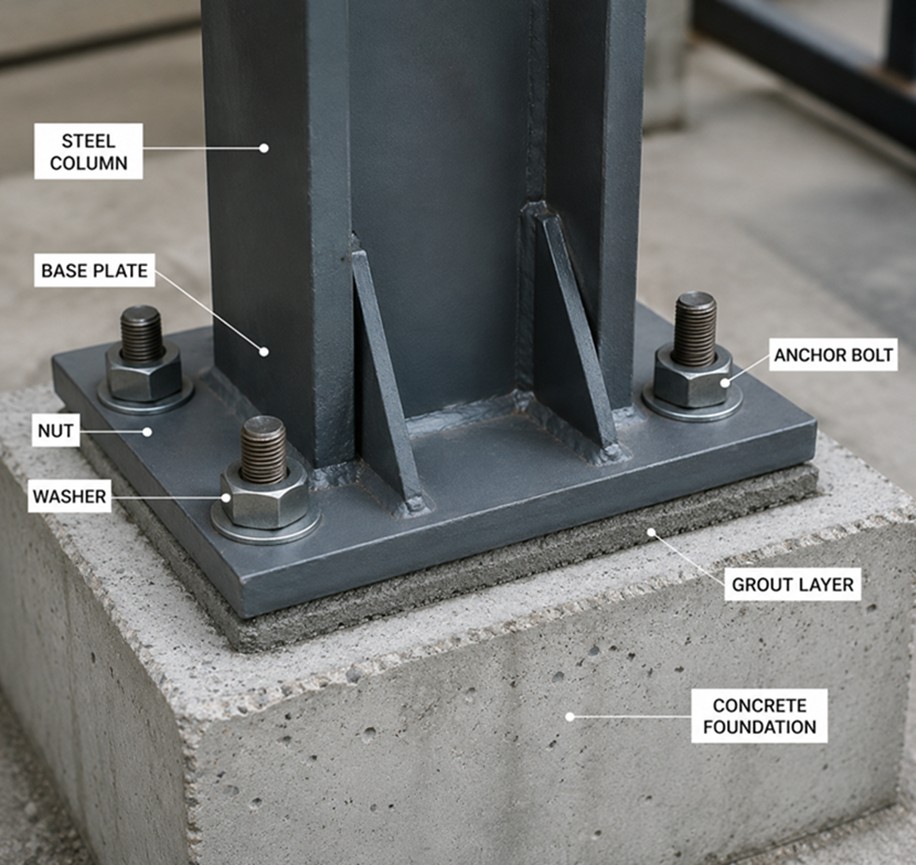
Ideal Grouting Stages in Baku:
- Cleaning and Roughening: The foundation concrete surface must be cleared of laitance and mechanically roughened to ensure a mechanical bond with the grout.
- Use of Leveling Nuts: To adjust height and plumb the column before final tightening of the top nuts.
- Non-Shrink Cementitious or Epoxy Grout: In heavy industrial projects under wind vibration, using 3-component epoxy grouts is mandatory due to their high tensile and chemical resistance against Baku’s saline atmosphere.
- Logistics Management, Heavy Transport, and Traffic Constraints in Baku Ports and Urban Corridors
One of the principal bottlenecks in the execution of large steel structures in Baku is the heavy transport of fabricated members. The Port of Baku (Alat) and the road networks leading to the city center are subject to specific traffic, clearance, and routing restrictions.
Just-In-Time Logistics Strategy
Due to limited staging space on construction sites in Baku and the risk posed by high winds—which can displace unstabilized stored members—the logistics system must be designed according to a Just-In-Time (JIT) model. Members should be marked, sequenced, and loaded at the fabrication plant—whether in Qaradagh or outside Azerbaijan—in exact accordance with the erection sequence.
Packaging and Securing Members on Trailer Beds
Because of strong crosswinds along Baku’s coastal highways, lighter components such as bracing members and purlins must be restrained using standard wire ropes and chains to prevent torsion, shifting, or falling during transport.
Coastal Storage Practices
If temporary laydown is unavoidable on site, members must not be placed directly on damp ground. Dry timber sleepers and waterproof yet breathable covers (breather membranes) are required to prevent moisture accumulation beneath plastic sheeting.
5. Crane Operations and Safe Lifting in High Winds
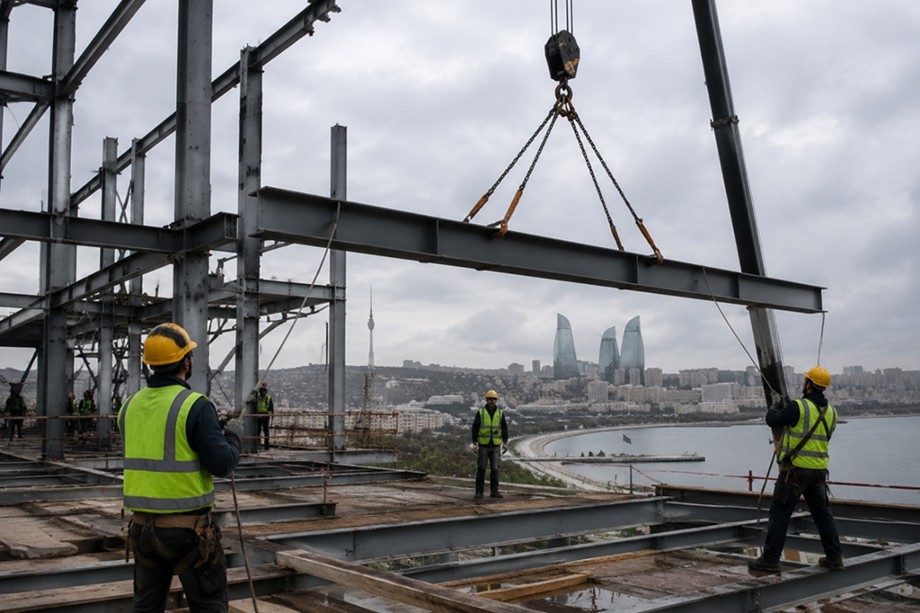
Rigging and lifting operations in Baku require real-time wind-speed monitoring. Wind speed at ground level may be 8 m/s, while at the elevation of the tenth floor it may exceed 15 m/s.
Formula for Wind Force on a Suspended Load
The wind force acting on a lifted member () is calculated as follows:
where is the projected wind area of the member and is the drag coefficient of the section—for example, approximately 2.0 for H-shaped sections and 1.2 for tubular members. The crane engineer must calculate derated crane capacity under lateral wind loading.
Double Tagline Technique
The use of tag lines is mandatory for every lifted member. In Baku, due to sudden wind-direction changes (wind shear), a single tagline is insufficient. Two control ropes must be installed at both ends of the member, with angles of approximately 30 to 45 degrees relative to the suspended piece, so that ground personnel can counteract the rotational moment induced by wind.
6. Temporary Bracing: The Backbone of Structural Stability
Many catastrophic collapses of steel structures worldwide have occurred during construction due to a failure to understand the importance of temporary bracing. Before the concrete slab is in place—acting as a rigid diaphragm—and before moment connections are fully welded or bolted, the steel frame behaves as a pinned and unstable system.
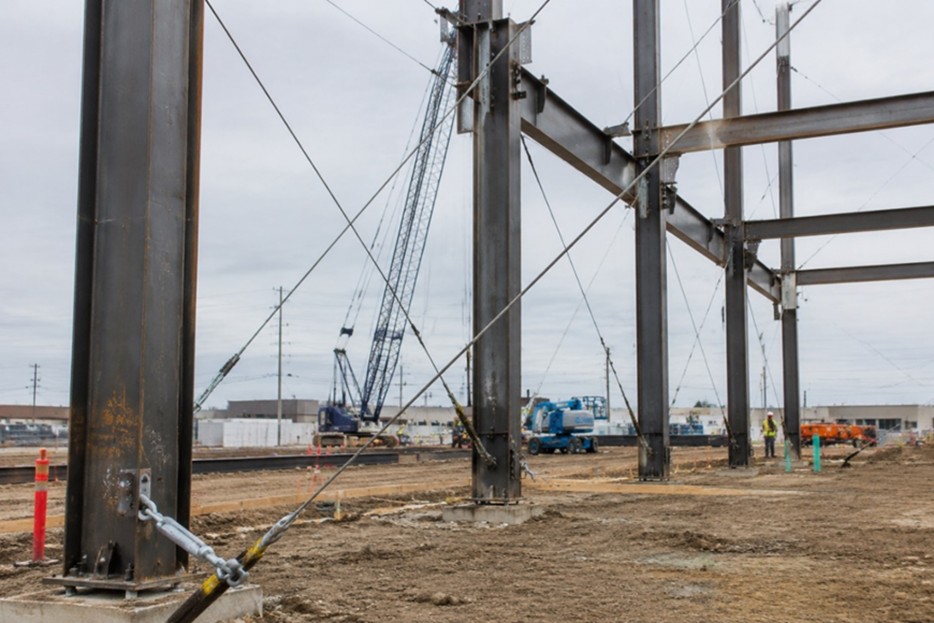
Principles for Designing a Temporary Bracing System
- Calculation of Construction Wind Loads
The return period for wind loads used in temporary bracing design is typically taken as 5 to 10 years, unlike the 50- or 100-year return periods used for the final structure. However, in Baku, due to the high frequency of severe winds, this value should not be taken as less than 75% of the final design wind load.
- Use of Guy Wires Equipped with Turnbuckles
Steel wire ropes with independent wire rope cores (IWRC) are the best option for temporary restraint because of their low elastic strain. Turnbuckles enable accurate calibration of cable pretension forces.
- Adjustable Telescopic Push-Pull Props
For stabilizing columns on the first through third levels, rigid tubular push-pull props are more effective than flexible cables, since they can resist both tension and compression.
7. Connection Technology and Advanced Quality Assurance / Quality Control (QA/QC) Methods
Connections in steel structures located in windy regions are exposed to dynamic fatigue due to cyclical stresses induced by wind vibration. Therefore, even minor defects in bolts or welds can rapidly propagate under repeated loading and lead to brittle fracture.
A) High-Strength Pretensioned Bolted Connections
In Baku, slip-critical connections using Grade 8.8 or 10.9 bolts per EN 14399, or ASTM A325/A490 bolts where applicable, are mandatory.
Bolt Tightening Methods
- Turn-of-Nut Method: In this procedure, bolts are first brought to a snug-tight condition and then further tightened by a prescribed additional rotation—such as one-third or one-half turn, depending on the standard table. This method is highly reliable in Baku’s humid and dusty atmosphere because it does not depend on torque wrench calibration.
- Tension Control Bolts (TC Bolts): These bolts have a splined end that shears off when the required pretension is reached. This method increases installation speed and makes visual quality control much easier.
B) Field-Welded Connections and Control of Atmospheric Conditions
Field welding in Baku’s open-air environment involves several technical challenges due to high wind speed:
- Disruption of Shielding Gas
In gas-shielded processes such as GMAW (CO₂/Argon), wind speeds above approximately 2 m/s can completely disrupt shielding gas coverage, resulting in porosity and slag inclusion defects.
- Practical Countermeasures
The recommended solution is to use Shielded Metal Arc Welding (SMAW) or self-shielded Flux-Cored Arc Welding (FCAW-S), which do not require externally supplied shielding gas. In addition, temporary welding enclosures or tents must be erected around the joint area.
- C) Advanced Non-Destructive Testing (NDT) Methods
For high-consequence projects—such as CC3 structures under Eurocode—visual testing (VT) alone is not sufficient.
- Phased Array Ultrasonic Testing (PAUT): Instead of higher-risk radiographic testing (RT), this method is used to detect internal flaws in complete joint penetration (CJP) welds of rigid beam-to-column connections and offers very high precision in three-dimensional defect mapping.
- Magnetic Particle Testing (MT) and Liquid Penetrant Testing (PT): These are used to detect surface cracks caused by residual stresses in the heat-affected zone (HAZ).
8. Advanced Metallurgy and Corrosion Protection Systems
Baku’s atmosphere is classified under ISO 12944-2 as C5-M—a very high corrosivity marine environment. Designing a corrosion-protection system for a structure with a 50-year service life in this class requires a multilayer strategy.
1. Surface Preparation
No coating system performs well on oxidized or contaminated steel. The steel surface must be blast-cleaned to ISO 8501-1 Sa 2.5 (near-white metal blast cleaning). The required anchor profile should be between 50 and 75 microns to maximize the mechanical adhesion of the primer.
- Three-Coat Paint System
For C5-M environments, this is the gold-standard system:
- Primer: An inorganic zinc-rich silicate (IOZ) primer with a minimum dry film thickness (DFT) of 75 microns. This layer acts as a sacrificial anode and provides cathodic protection.
- Intermediate Coat: An epoxy MIO (micaceous iron oxide) or glass-flake epoxy coat with a minimum thickness of 150 microns. This layer acts as an impermeable physical barrier against moisture and chloride ions.
- Topcoat: Aliphatic polyurethane with a minimum thickness of 60 microns. This layer provides final resistance against strong ultraviolet radiation along the Baku shoreline and against abrasion caused by sandstorms, while also preventing chalking.
3. Hot-Dip Galvanizing
For secondary members such as purlins, secondary braces, fire-escape stairs, and industrial platforms, hot-dip galvanizing with a zinc coating thickness of at least 85 microns per ISO 1461 is the most reliable option, providing a service life of more than 30 years with no maintenance requirement.
9. Structural Monitoring and Value Engineering (LCC Analysis)
In a wind-exposed city like Baku, the “Initial Cost” of a steel structure is only part of the story. A professional engineer must consider the Life Cycle Cost (LCC).
Value Engineering (VE) Approach:
By using high-strength steel (e.g., S355 instead of S235), the total weight of the structure can be reduced by up to 15%. This reduction directly lowers the wind-effective surface area and the foundation load, resulting in a more economical and resilient design.
- Frequently Asked Questions (FAQ)
- Q1: Why is steel preferred over concrete in Baku?
- A: Due to Baku’s seismic activity and soft coastal soils, the high strength-to-weight ratio of steel reduces the total building weight, minimizing foundation settlement and seismic forces.
- Q2: How often should the C5-M coating be inspected?
- A: In coastal zones, a visual inspection every 5 years is recommended to identify localized corrosion spots before they compromise structural integrity.