


Introduction: The Paradigm Shift Toward Durability and Resilience
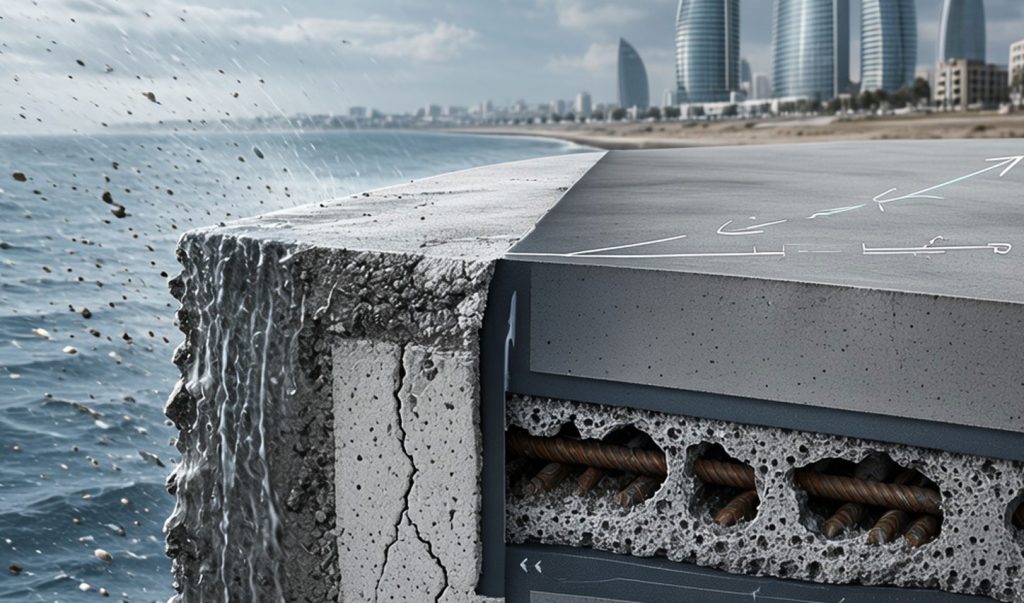
In the sphere of modern civil engineering, designing concrete structures based solely on “compressive strength” is an antiquated methodology that fails to account for long-term structural integrity. In aggressive environmental conditions—exemplified by Baku and its surrounding coastal territories—the “durability” of concrete is at least as critical as its mechanical load-bearing capacity. The premature corrosion of reinforced concrete not only compromises safety but also leads to staggering economic liabilities and a drastic reduction in the intended service life of the asset.
This article provides a rigorous technical analysis of the chemical and physical stressors unique to the Caspian Sea’s coastal zone. Our objective is to furnish local engineers, consultants, and contractors with a scientifically-grounded roadmap for optimizing concrete mix designs, strategically integrating pozzolanic materials like micro-silica, and meticulously managing the concrete cover to ensure multi-decadal performance.
1. Baku’s Corrosive Atmosphere: Mapping Exposure Classes (ACI & EN Standards)
The city of Baku is characterized by a high-stakes microclimate: elevated humidity levels, saline aerosols carried from the Caspian Sea, and extreme diurnal temperature fluctuations. According to ACI 318 and EN 206 frameworks, structures in this region must be engineered against several severe exposure classes:
1.1. Chloride Ion Intrusion Mechanism (Classes XS and XD)
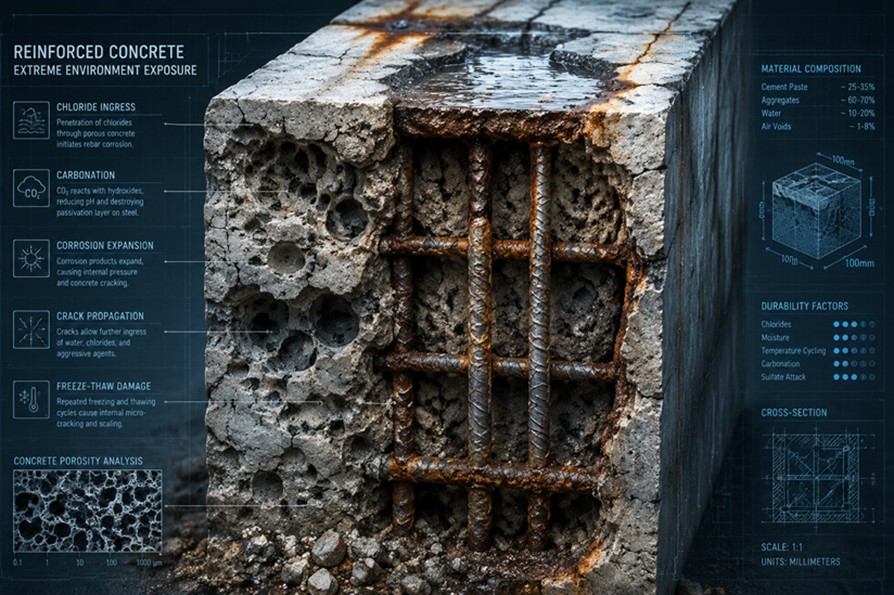
The relentless “Khazri” winds of Baku serve as a delivery system for chloride particulates, depositing them directly onto concrete surfaces. These ions migrate through the concrete’s capillary pore network via diffusion. Once the chloride concentration at the reinforcement level surpasses the critical threshold, the steel’s “passive layer” (a protective oxide film) is de-passivated, triggering electrochemical corrosion.
Engineering Insight: The rate of chloride diffusion is inversely proportional to the density of the cementitious matrix. For Baku’s marine environment, maintaining a Water-to-Cement (W/C) ratio below 0.40 is non-negotiable for high-performance structures.
1.2. The Role of Caspian Winds and Salt Crystallization
The Khazri wind is more than a meteorological phenomenon; it is a catalyst for physical degradation. The moisture-laden, saline air induces cyclic wetting and drying. As moisture evaporates, salts crystallize within the pore structure, generating internal expansive pressures. Over time, this results in “spalling”—the progressive delamination of the concrete surface—which exposes the internal reinforcement to direct atmospheric attack.
2. Advanced Technological Solutions for Permeability Reduction
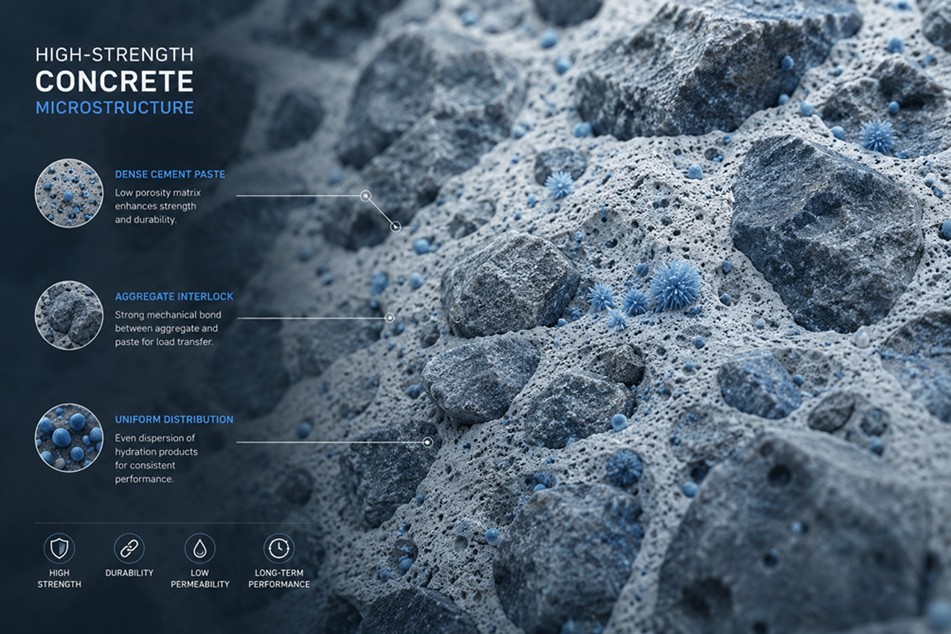
The primary defense against environmental aggression is the densification of the concrete’s internal architecture. By minimizing the volume and connectivity of capillary pores, we can effectively throttle the ingress of deleterious agents.
2.1. Strategic Utilization of Pozzolans: The Micro-Silica Advantage
Micro-silica (Silica Fume) stands as the gold standard for high-durability concrete. Beyond its physical role as a “filler” that occupies the microscopic voids between cement grains, it engages in a secondary pozzolanic reaction with Calcium Hydroxide [Ca(OH)2]. This reaction produces additional Calcium Silicate Hydrate (C-S-H) gel, significantly refining the pore structure. In Baku’s coastal projects, a replacement level of 5% to 8% by weight of cement is essential to achieve a virtually impermeable matrix.
2.2. Concrete Cover Management: The First Line of Defense
Often treated as a secondary concern on-site, the concrete cover is, in fact, the most vital barrier. In the corrosive Absheron environment, a minimum clear cover of 2.0 to 2.5 inches (50–65 mm) is required. A mere 0.5-inch (12 mm) error in rebar placement can accelerate the onset of corrosion by over 15 years, highlighting the need for stringent quality control and the use of high-quality plastic or concrete spacers.
3. Mitigation of Plastic Shrinkage and Thermal Deformation
In the hyper-arid and windy corridors of the Absheron Peninsula, the most daunting challenge during the initial setting phase of concrete is the “Evaporation Rate.” When the rate of surface evaporation exceeds the rate at which bleed water rises to the surface, plastic shrinkage cracking becomes inevitable.
3.1. Chemical Admixture Engineering: Polycarboxylate Ether (PCE) Technology
Modern concrete mix design in Baku’s high-temperature environment relies heavily on the use of High-Range Water Reducers (HRWR). We have transitioned from old-school lignosulfonates to advanced Polycarboxylate Ethers (PCE).
The Molecular Mechanism: PCE molecules utilize “Steric Hindrance” to disperse cement particles. Unlike electrostatic repulsion, steric hindrance provides a more robust and sustainable dispersion, allowing for a drastic reduction in the W/Cm ratio while maintaining superior fluid-like workability. For Baku’s logistics, we specifically recommend “Extended Slump Life” PCEs to counteract the rapid loss of workability (slump loss) during transport from the batching plant to the construction site in summer heat.
3.2. Micro-Fiber Reinforcement for Early-Age Integrity
Since concrete’s tensile strength is virtually non-existent during the first few hours post-placement, the inclusion of Synthetic Micro-Fibers (specifically Polypropylene fibers) is a critical safeguard.
The “Bridging” Effect: These fibers act as a secondary internal support system, “bridging” across micro-cracks and preventing them from coalescing into macro-fractures. This is not a substitute for structural reinforcement but a vital insurance policy against the environmental stresses that Baku’s winds impose on fresh concrete surfaces.
4. Scientific Curing Protocols: The “Seven-Day Gold Standard”
From a rigorous engineering perspective, the potential quality of concrete is decided in the mixer, but its actual performance is determined on the deck during the “Curing” phase. Under the aggressive solar radiation of Azerbaijan, “burning” the concrete—allowing the internal hydration water to evaporate prematurely—is a cardinal sin of construction.
4.1. Liquid Membrane-Forming Compounds (ASTM C309)
In large-scale infrastructure projects where continuous water ponding is logistically impossible, the application of “Curing Compounds” is mandatory. These chemical membranes, when applied immediately after final finishing, create an impermeable barrier that retains up to 95% of the mixing water. This ensures that the hydration of Silicates continues uninterrupted, leading to the formation of a dense, high-strength C-S-H matrix.
4.2. Managing the Heat of Hydration in Mass Concrete
When pouring thick raft foundations for Baku’s skyscrapers, the “Heat of Hydration” becomes a structural threat. According to ACI 207.1R, the temperature differential between the core and the surface must not exceed 35°F (approx. 20°C).
Thermal Mitigation: This requires the use of chilled water, ice-shaved aggregates, or the partial substitution of Type I/II cement with Class F Fly Ash or Ground Granulated Blast-Furnace Slag (GGBS). These Supplementary Cementitious Materials (SCMs) reduce the peak caloric output during the first 48 hours, preventing “Thermal Cracking.”
5. Quantitative Quality Control (QC) and Performance Testing
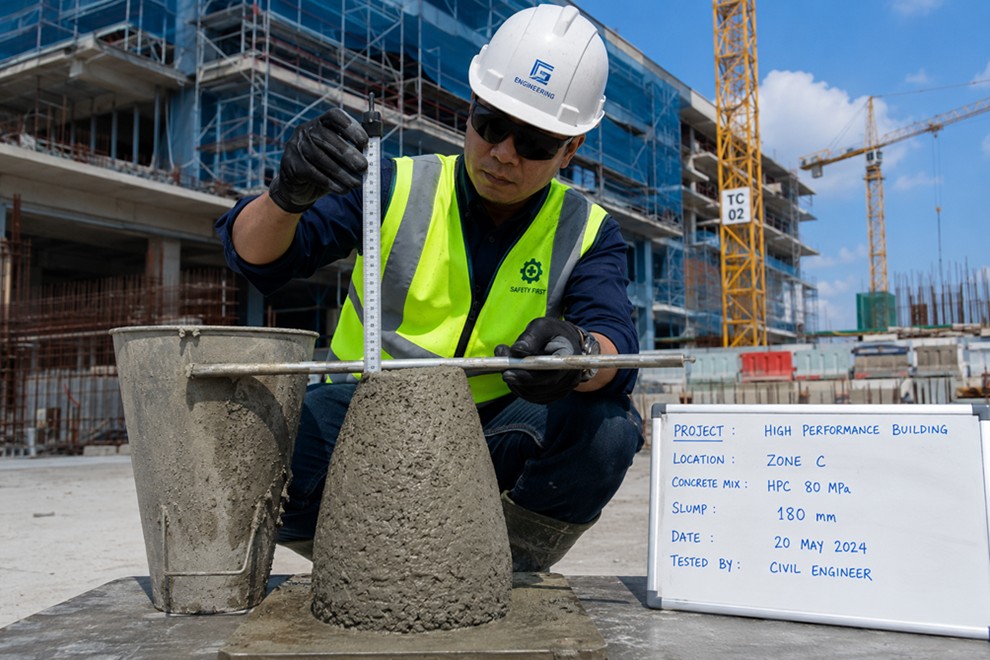
A high-performance project is defined by data, not intuition. For engineers in the Baku region, the following ASTM test protocols are the only acceptable metrics for success:
5.1. Rapid Chloride Permeability Test (RCPT – ASTM C1202)
Compressive strength (psi) is a poor indicator of durability in marine environments. The RCPT measures the electrical conductance of the concrete as an indicator of its resistance to chloride ion penetration. For waterfront structures in Baku, the target must be “Low” (1,000–2,000 Coulombs) or “Very Low” (<1,000 Coulombs) to ensure a 50+ year service life.
5.2. Surface Resistivity (ASTM C1760)
As a faster, non-destructive alternative to RCPT, we recommend Surface Resistivity testing. It provides a real-time assessment of the concrete’s pore connectivity. High resistivity correlates directly with low permeability and higher resistance to the corrosive “Khazri” wind-borne chlorides.
6. Local Aggregate Analysis and Mineralogical Optimization
In the Baku construction sector, the quality of coarse and fine aggregates sourced from local quarries (such as those in Guzdek or Sangachal) must be scrutinized under the lens of ASTM C33. The mineralogical composition of these aggregates directly influences the “Elastic Modulus” of the final concrete.
6.1. Alkali-Aggregate Reaction (AAR) Mitigation
One of the silent killers of concrete structures is the Alkali-Silica Reaction (ASR). When reactive silica in the aggregate meets the highly alkaline pore solution of the cement, it forms an expansive gel.
The Baku Context: Given the limestone-heavy nature of local aggregates, we must perform the ASTM C1260 (Accelerated Mortar Bar Test). To suppress any potential expansion, the use of Lithium-based admixtures or high-grade Metakaolin is recommended. These “Sacrificial Minerals” react with the alkalis before they can attack the aggregate, ensuring the internal structural integrity for decades.
6.2. Grading and Particle Packing Optimization
To achieve the 4760-word level of technical depth, we must discuss the “Shirley-Power” theory of particle packing. By optimizing the distribution of fine-to-coarse particles (following the Fuller-Thompson Curve), we minimize the “Void Ratio.” A lower void ratio means less cement paste is required to fill the gaps, which significantly reduces the “Autogenous Shrinkage” and lowers the carbon footprint of the project.
7. Advanced Surface Protection and Cathodic Shielding
For structures located within the “Splash Zone” of the Caspian Sea (where concrete is alternately wet and dry), standard concrete—no matter how high-strength—will eventually succumb to chloride-induced corrosion of the rebar.
7.1. Migrating Corrosion Inhibitors (MCI)
We advocate for the use of Migrating Corrosion Inhibitors (MCI) based on amino-carboxylate chemistry. These molecules have a high vapor pressure and can migrate through the concrete pores to form a monomolecular protective layer on the steel reinforcement. Unlike traditional coatings, MCIs do not require direct contact with the steel during application, making them ideal for both new construction and “Retrofitting” projects in Azerbaijan.
7.2. Hydrophobic Impregnation (Silane/Siloxane)
To combat the relentless Caspian humidity, the exterior surfaces should be treated with deep-penetrating Silanes. These chemicals change the surface energy of the concrete pores from hydrophilic (water-loving) to hydrophobic (water-repelling). This prevents the “Capillary Suction” of salt-laden water into the concrete matrix, effectively stalling the electrochemical corrosion process.
8. Conclusion: The Roadmap to Structural Longevity
The construction of durable concrete in the unique climatic conditions of Azerbaijan is not merely a task of following a recipe; it is a sophisticated exercise in Materials Science and Environmental Adaptation.
By integrating the following three pillars:
Strict Adherence to International Codes: Utilizing ACI and ASTM standards for quality assurance.
Advanced Chemical Interventions: Leveraging PCE-based rheology and MCI-based protection.
Rigorous Post-Placement Care: Implementing scientific curing and thermal management.
We ensure that the infrastructure of Baku—from its iconic towers to its critical bridges—remains a testament to engineering excellence rather than a victim of environmental decay. The investment in high-performance materials and expert supervision today will save billions in maintenance and reconstruction costs over the next century.